Paydaypeek
EB
Elena Brooks
Certified Financial Planner (CFP®) · Updated September 2026

Elena Brooks
Certified Financial Planner (CFP®) · Updated September 2026
Imagine you are sitting at your kitchen table on a Tuesday evening. You have just received an unexpected invoice for $3,500 to cover a sudden dental emergency or perhaps a necessary car repair. Your first instinct might be to look for quick cash, but in 2026, the way we approach these financial moments has evolved significantly. This is where the concept of Paydaypeek becomes relevant—the practice of looking through the window of potential loan offers to understand your true cost before you ever commit to a signature.
Many borrowers make the mistake of rushing into the first offer they see, often driven by the stress of an immediate need. However, understanding how to 'peek' at your financial options can save you thousands in interest over time. In 2026, we have seen that transparency is increasing, yet the math behind these loans remains complex. A borrower might find a loan with a low monthly payment, but if that term spans five years, they could end up paying double what they originally borrowed.
This article is designed to help you navigate this landscape with confidence. We will walk through how to analyze interest rates, why certain 'pre-qualification' steps are safer than others, and how to use specific mathematical frameworks to ensure a loan serves your needs rather than compounding your debt. It is vital to remember that these insights are for informational purposes only—understanding the landscape is the first step toward responsible financial management.
As we dive into the details, keep in mind several key statistics from recent 2026 market data: typical personal loan APRs currently range from 8% to 36%, depending on your credit profile; most lenders can provide a decision within minutes, though actual funding may take two to five business days; and the average borrower seeks amounts between $1,000 and $50,000. Knowing these benchmarks allows you to spot when an offer is standard and when it might be outlier territory.
In the modern digital economy, the term 'pre-qualification' is often used loosely. For a savvy borrower in 2026, it is essential to distinguish between a simple peek at your eligibility and a formal application that alters your credit history. Many tools allow you to see what rates you might qualify for without impacting your score, but this is not universal. The Consumer Financial Protection Bureau (CFPB) has frequently emphasized the importance of lenders being clear about whether an inquiry is a 'soft pull' or a 'hard pull.'
A soft credit inquiry is like looking at a menu in a restaurant; it gives you an idea of what to expect without any commitment. This is often how Paydaypeek-style evaluations work—they allow you to gauge your standing with multiple lenders simultaneously. Conversely, once you move from 'peeking' to 'applying,' most lenders will perform a hard inquiry, which can lead to a temporary dip in your credit score.
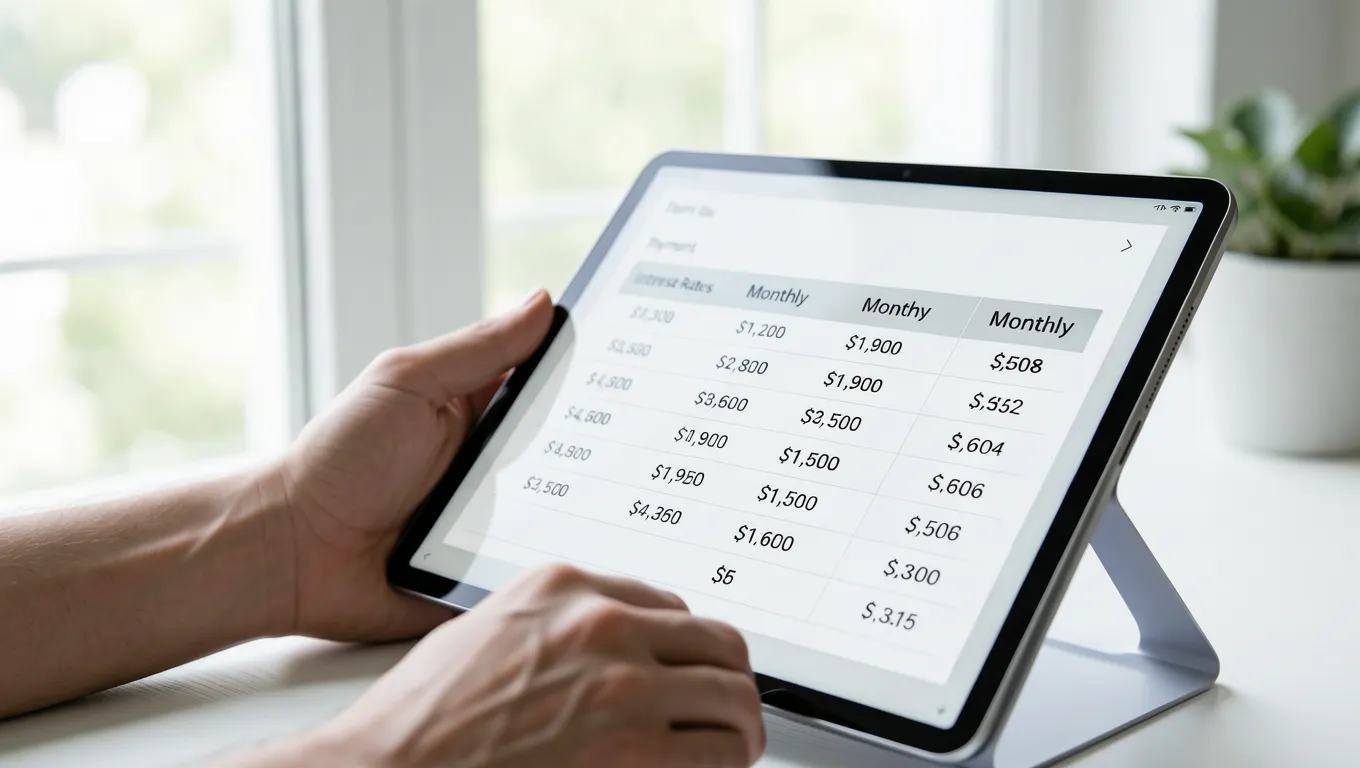
The most common pitfall for borrowers is focusing solely on the monthly payment amount while ignoring the total cost of the loan. A lower monthly payment sounds attractive when you are managing a tight budget, but it often comes at the price of a much longer repayment term or a higher interest rate. To truly understand your obligation, you must run the numbers through a calculator that accounts for both APR and duration.
Let us look at three distinct scenarios to see how these variables interact in real-world terms:
Scenario A: You need $5,000 for an urgent repair. If you secure a loan at 12% APR over 24 months, your monthly payment will be approximately $237.60. Over the life of the loan, you will pay back roughly $5,702.40.
Scenario B: You are looking to consolidate higher-interest debt with a $15,000 loan at 18% APR over 36 months. Your monthly payment would be approximately $537.00, but notice the total repayment reaches roughly $19,332. The interest cost here is significant.
Scenario C: A smaller, high-interest emergency loan of $2,500 at 29% APR for only 12 months results in a monthly payment of about $243.00. While the monthly cost feels similar to Scenario A, you are paying much more per dollar borrowed due to the high interest rate.
By running these comparisons, you can see that 'affordability' is not just about what leaves your bank account each month, but how much of your hard-earned money is actually going toward the principal versus the lender's profit.
When you begin exploring your options, you will likely encounter two different strategies for gathering information. Choosing the right one depends on how much certainty you need versus how much you want to protect your credit score.
Strategy One is the 'Broad Sweep' approach. This involves using multiple pre-qualification tools that utilize soft inquiries. The trade-off here is speed and safety; you can see a wide range of potential lenders without any risk to your credit profile. However, the rates you see in this phase are merely estimates. They are a 'peek' into what might be possible, but they are not legally binding offers.
Strategy Two is the 'Direct Application' approach. This involves submitting formal applications to specific lenders. The trade-off here is accuracy and certainty; once an application is processed, you will have a firm interest rate and exact terms. The downside is that this triggers hard inquiries, which can stack up if you apply to too many lenders in a short window.
We recommend starting with the 'Broad Sweep' to narrow down your options. Once you have identified two or three lenders that offer rates within your target range, you can then proceed to formal applications. This method gives you more control over your financial footprint and prevents the common mistake of multiple hard inquiries appearing on your report in a single week.
Once you have moved past the initial 'peek' phase and have actual offers on the table, you need a framework to decide which one is truly best for your situation. Do not let the excitement of receiving funds cloud your judgment. Instead, follow this four-step decision matrix:
1. Verify the APR vs. Interest Rate: The interest rate only tells part of the story. The Annual Percentage Rate (APR) includes both the interest and any origination fees or mandatory insurance. Always compare offers based on the APR.
2. Calculate the Total Cost of Borrowing: Take the monthly payment, multiply it by the total number of months, and subtract the original principal. This tells you exactly how much the loan is costing you in real dollars.
3. Check for Prepayment Penalties: Some lenders charge a fee if you decide to pay the loan off early. If you plan to use a tax refund or a bonus to settle the debt quickly, ensure your contract allows this without penalty.
4. Audit the Fee Structure: Look closely at 'origination fees' which are often deducted from your loan proceeds before you even receive the money.
For example, if you borrow $5,000 but the lender charges a 3% origination fee, you may only see $4,850 in your bank account, despite being responsible for repaying the full $5,000 plus interest. Always calculate your budget based on the amount you will actually receive, not the amount you are borrowing.
Many borrowers are surprised to find that a rate they saw during a pre-qualification stage is higher when they actually apply. This isn't necessarily a sign of predatory behavior, but rather the result of complex economic variables and lender risk models. In 2026, several factors play a critical role in how these rates are determined.
First, there is the macro-economic context provided by the Federal Reserve. When the Fed adjusts interest rates to combat inflation or stimulate growth, the cost of capital for lenders changes. This shift trickles down directly to you; if the benchmark rates rise, your personal loan APR will likely follow suit.
Second, your 'debt-to-income' (DTI) ratio is a massive factor that many people overlook during their initial peek. Even with an excellent credit score, if a large portion of your monthly income is already committed to rent or existing debt, lenders may view you as higher risk and offer a higher APR to compensate for that risk.
Third, the specific 'lender appetite' can change overnight. Lenders often have internal quotas for certain types of borrowers. For instance, one lender might be aggressively seeking customers with 700 credit scores this month, while another may have shifted its focus toward higher-risk profiles to balance its portfolio. This is why comparing multiple sources—perhaps using a resource like PaydaySeek to see various options—can provide the nuance needed to find the best fit for your specific profile.
As you navigate the market, it is vital to remain vigilant against certain types of predatory structures that can turn a helpful loan into a financial burden. While most mainstream lenders follow strict regulations, the complexity of modern finance provides ample room for confusion.
One major red flag is the 'teaser rate.' This is an offer where you are quoted a very low interest rate for the first three to six months, after which the rate jumps significantly to a standard (and much higher) APR. While this might seem helpful for short-term relief, it can be incredibly deceptive if you do not realize your long-term costs will skyrocket.
Another pitfall is the 'add-on product' trap. You may see options during the application process to include credit insurance or wellness protection. These are often optional and significantly increase your monthly payment and total loan cost. Always evaluate whether these protections are truly necessary for your specific situation before checking the box.
Finally, be wary of lenders that demand upfront fees before you receive any part of your loan. In the United States, it is generally illegal for a legitimate lender to charge a fee before they have provided the funds. If a company asks for a 'processing fee' or 'insurance deposit' via a wire transfer or gift card, walk away immediately. Legitimate lenders wrap their costs into the APR and deduct them from the loan amount itself.
If this option fits your situation, it's also worth comparing bad credit loans and payday loans for bad credit.